
26
Oct
Share
Comments Off on VOCs and Formaldehyde: What You Are Breathing in a New or Renovated Home For Buyers
VOCs and Formaldehyde: What You Are Breathing in a New or Renovated Home
By Raymond Ward, Florida Licensed Home Inspector HI1164 – All Inspections 4U
That “new home smell” is not the smell of clean. It is the smell of chemicals evaporating out of new paint, flooring, cabinets, adhesives, and furniture. Most of it fades with time. Some of it lingers, and in a closed-up Florida home with the air conditioning running, it has nowhere to go.
What VOCs are
Volatile organic compounds, or VOCs, are gases released by thousands of everyday products: paints and finishes, glues, flooring, cabinets, cleaning products, air fresheners, and more. According to the U.S. Environmental Protection Agency, concentrations of many VOCs are consistently higher indoors than outdoors, up to ten times higher. EPA studies found about a dozen common organic pollutants at levels two to five times higher inside homes than outside, whether the homes were in rural or industrial areas.
Formaldehyde, the most common one
Formaldehyde is the VOC most people have heard of, and for good reason. It is used in the resins that hold together composite wood, such as particleboard, medium-density fiberboard (MDF), and hardwood plywood. Those materials are found in cabinets, flooring, shelving, doors, and furniture. Formaldehyde also comes from some glues and finishes, permanent-press fabrics, gas stoves, and tobacco smoke.
It can irritate the eyes, nose, and throat, and it can trigger asthma attacks. The International Agency for Research on Cancer classifies formaldehyde as carcinogenic to humans.
Why new and renovated homes are different
- New materials release the most. Emissions are highest when products are new and decline over time.
- Heat and humidity raise emissions. Formaldehyde release increases with higher temperature and humidity, which describes much of the South Florida year.
- Tight houses hold it in. Newer homes are built to keep conditioned air in, which also keeps chemical vapors in.
- Closed-up homes concentrate it. A new or vacant home that has been shut for weeks can have much higher levels than the same home once people are living in it and opening doors.
The limits are on the products, not on your air
Federal law sets formaldehyde emission limits for composite wood panels under Title VI of the Toxic Substances Control Act, and compliant products are labeled. That is real progress. But those limits apply to the panels as they are manufactured. There is no single federal limit for VOCs in the air of a private home. A home full of compliant products can still have elevated levels, especially when everything is new at once.
Signs worth paying attention to
- A chemical odor that does not fade after the first few weeks.
- Eye, nose, or throat irritation, or headaches, that improve when you are away from the home.
- Asthma that gets worse after moving in or after a renovation.
Anyone with health symptoms should talk to a doctor. Air testing tells you what is in the air. It is not a medical diagnosis.
When testing makes sense
- After new construction, a major renovation, or new flooring or cabinets.
- When a chemical odor persists.
- When someone in the home has asthma or chemical sensitivity, or there is a new baby.
- Before buying a newly built or recently renovated home, especially a quick flip.
- After cleanup or remediation work, to confirm the air has returned to normal.
How air testing works
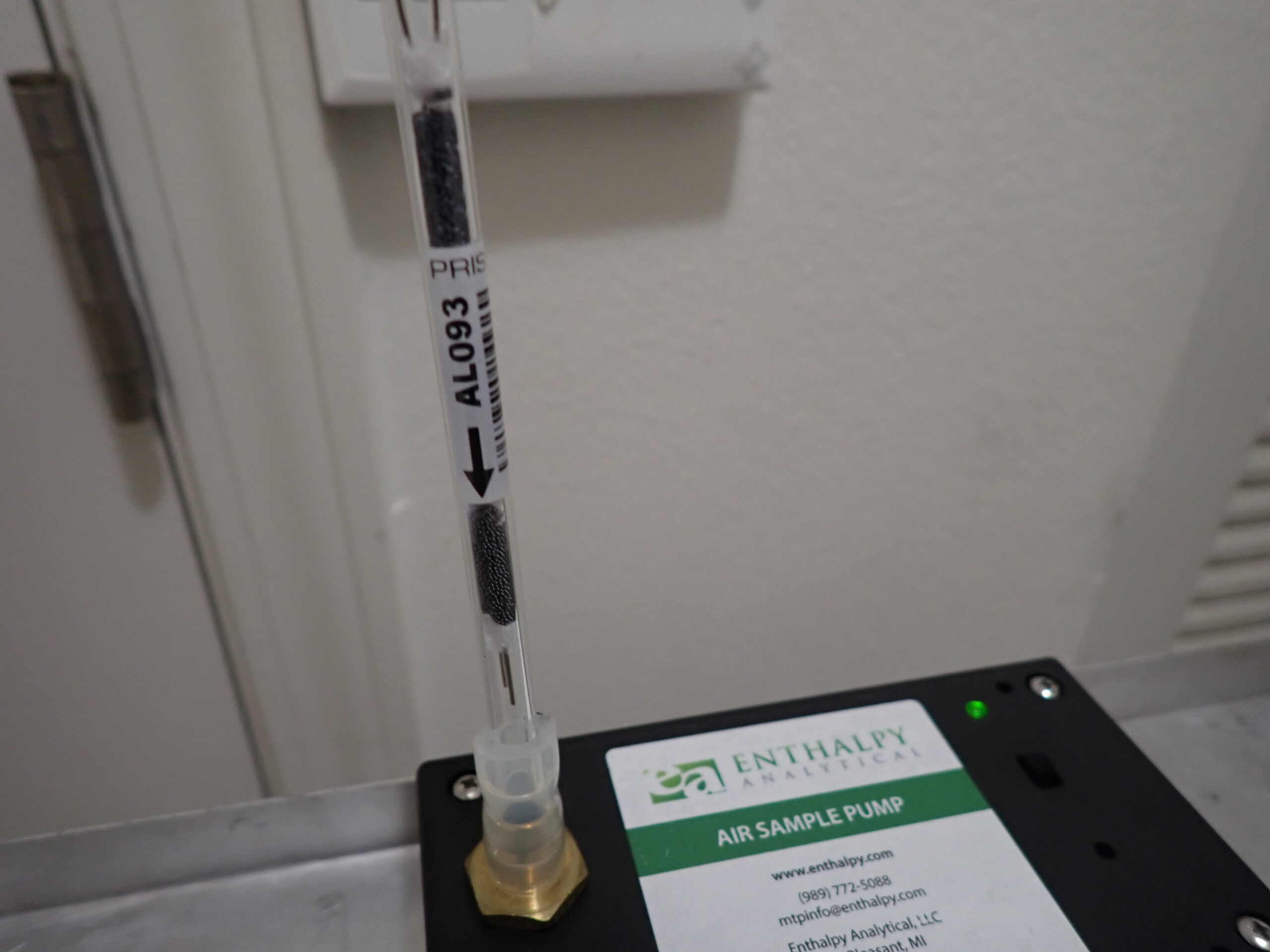
Air samples are collected inside the home, often with an outdoor sample for comparison, and sent to an independent laboratory. The results list the compounds found and their concentrations. Conditions matter: the house should be closed up beforehand and the air conditioning operating normally, so the sample reflects how you actually live in the home. A good report explains the results in plain language and compares them to published guidelines.
Practical ways to lower levels
- Open windows when the weather allows, and run the bathroom and kitchen exhaust fans.
- Give new materials time. When possible, let new cabinets, flooring, and furniture air out before moving in.
- Keep temperature and humidity moderate. Both drive emissions up.
- Choose low-VOC products and composite wood labeled as compliant with TSCA Title VI.
- Store paints and solvents outside the living space, not in closets or under sinks.
- Skip the air fresheners. They add VOCs; they do not remove them.
- Know what your filter does. Ordinary HVAC filters capture particles, not gases. Removing gases takes ventilation or an air cleaner with activated carbon.
If you are hiring someone to test indoor air
Three questions worth asking:
- Does the test cover formaldehyde only, or a full VOC panel?
- Which laboratory analyzes the samples, and is it accredited?
- Will the report explain the results in plain language and compare them to published guidelines?
About the author
Raymond Ward is a Florida licensed Home Inspector (HI1164) and Mold Assessor (MRSA-2391), InterNACHI and CCPIA certified, and the owner of All Inspections 4U. The company performs home, 4-point, wind mitigation, and environmental inspections throughout Miami-Dade, Broward, and Palm Beach counties. To schedule, call 954-802-8524 or visit www.allinspections4u.com.
Related service: Volatile Organic Compounds and Formaldehyde Testing
This article is general information, not medical advice. References: U.S. EPA, Volatile Organic Compounds’ Impact on Indoor Air Quality; U.S. EPA, Formaldehyde Emission Standards for Composite Wood Products (TSCA Title VI); International Agency for Research on Cancer.


