
06
Nov
Share
Comments Off on Chinese Drywall in Florida Homes: How to Recognize It Before You Buy For Buyers
Chinese Drywall in Florida Homes: How to Recognize It Before You Buy
By Raymond Ward, Florida Licensed Home Inspector HI1164 – All Inspections 4U
Nearly twenty years after the problem came to light, Chinese drywall still turns up in Florida homes. During the housing boom and the rebuilding that followed the 2004 and 2005 hurricanes, American-made drywall was in short supply, and builders used imported drywall, much of it from China. Some of that drywall releases sulfur gases that corrode copper and other metals. Florida was one of the hardest-hit states.
If you are buying a home built or renovated during those years, here is what to know.
What the problem is
Problem drywall gives off sulfur compounds, including hydrogen sulfide. Those gases react with copper and silver, turning them black. Over time this damages the copper in electrical components and in air conditioning coils. The reaction gets worse with heat and humidity, which is why Florida homes show it so clearly. Many homeowners also notice a sulfur or “rotten egg” odor.
Which homes are at risk
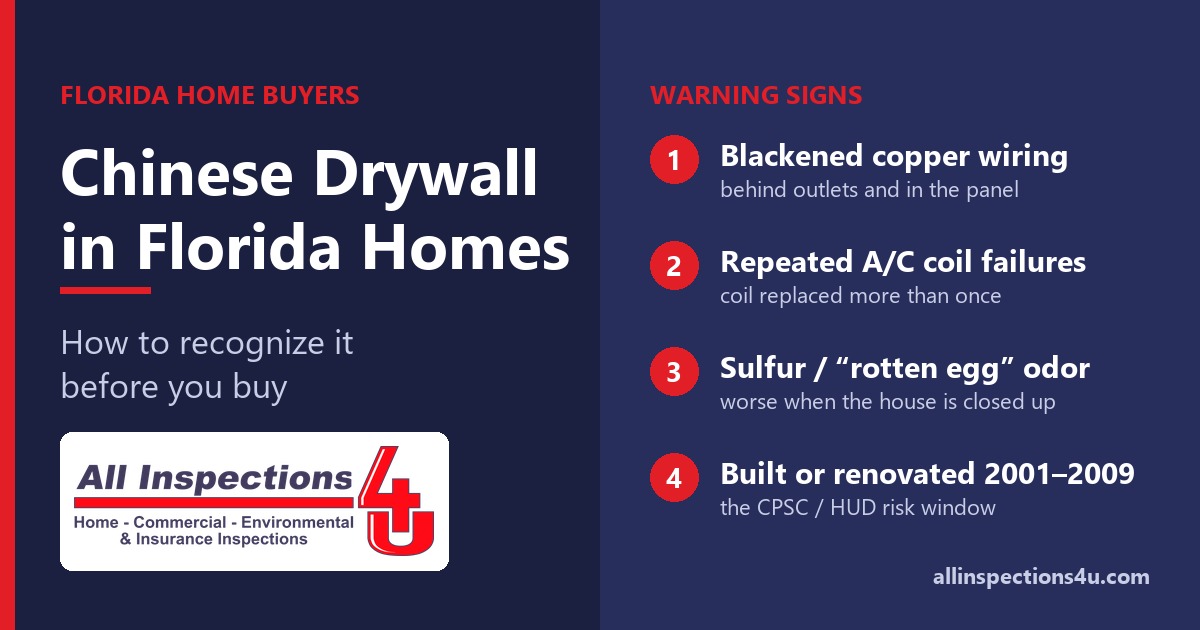
Federal guidance from the U.S. Consumer Product Safety Commission (CPSC) and the Department of Housing and Urban Development (HUD) focuses on drywall installed from 2001 through 2009. Some drywall installed in 2009 had been imported years earlier and sat in warehouses. The window applies to renovations and additions too: an older home that was remodeled in 2006 can have problem drywall in the new rooms only.
Warning signs
- Blackened copper. Look at the bare copper ground wires behind outlet and switch covers, and in the electrical panel. Problem drywall leaves a black, sooty coating. Ordinary corrosion on copper is usually green or blue, and it is not the same thing.
- Repeated air conditioning failures. An evaporator coil that has been replaced more than once in a few years is a classic sign.
- A sulfur odor, especially when the house has been closed up and warm.
- Tarnished silver items or fixtures that blacken quickly.
How it is confirmed
A visual inspection can raise the question, but it cannot answer it alone. The CPSC and HUD identification guidance uses two steps. First, a threshold: blackened copper in the home, together with drywall installed during the affected years. Second, corroborating evidence, such as markings on the back of the drywall showing Chinese origin, laboratory testing of drywall samples for elemental sulfur, or laboratory confirmation that the corrosion on the copper is copper sulfide.
What federal guidance says about repairs
The CPSC and HUD remediation guidance calls for replacing:
- All of the problem drywall.
- All smoke alarms and carbon monoxide alarms.
- Electrical distribution components, including receptacles, switches, and circuit breakers.
- Gas service piping and fire sprinkler systems, where present.
In 2011 the agencies stopped recommending the removal of all electrical wiring, after a study found that the corrosion did not create an electrical safety hazard in the wiring itself. Even so, proper remediation means opening walls throughout the affected areas. It is a major project.
Buying a home that was already remediated
A home that was properly remediated can be a perfectly sound home. The key word is documented. Ask for the scope of work, which rooms and materials were replaced, the permits, and any clearance or post-remediation testing. A home with complete records is a known quantity. A home with no records is a question mark.
What Florida sellers must tell you
Under Florida law, a seller must disclose known facts that materially affect the value of a home and are not readily observable to the buyer. If a home falls in the affected years, ask the seller in writing whether problem drywall was ever found, tested for, or repaired. This is general information, not legal advice; your real estate attorney can tell you how it applies to your purchase.
If you are hiring an inspector
Three questions worth asking:
- Will you look at the copper behind outlet covers, in the electrical panel, and at the air conditioning coil?
- Can you tell the difference between sulfide blackening and ordinary corrosion?
- If you find warning signs, what testing can you arrange to confirm or rule it out?
About the author
Raymond Ward is a Florida licensed Home Inspector (HI1164) and Mold Assessor (MRSA-2391), InterNACHI and CCPIA certified, and the owner of All Inspections 4U. The company performs home, 4-point, wind mitigation, and environmental inspections throughout Miami-Dade, Broward, and Palm Beach counties. To schedule, call 954-802-8524 or visit www.allinspections4u.com.
Related service: Chinese Drywall Inspections
This article is general information, not legal advice. References: U.S. Consumer Product Safety Commission and U.S. Department of Housing and Urban Development, Identification and Remediation Guidance for Homes with Problem Drywall (2011, updated 2013); Johnson v. Davis, 480 So. 2d 625 (Fla. 1985).


